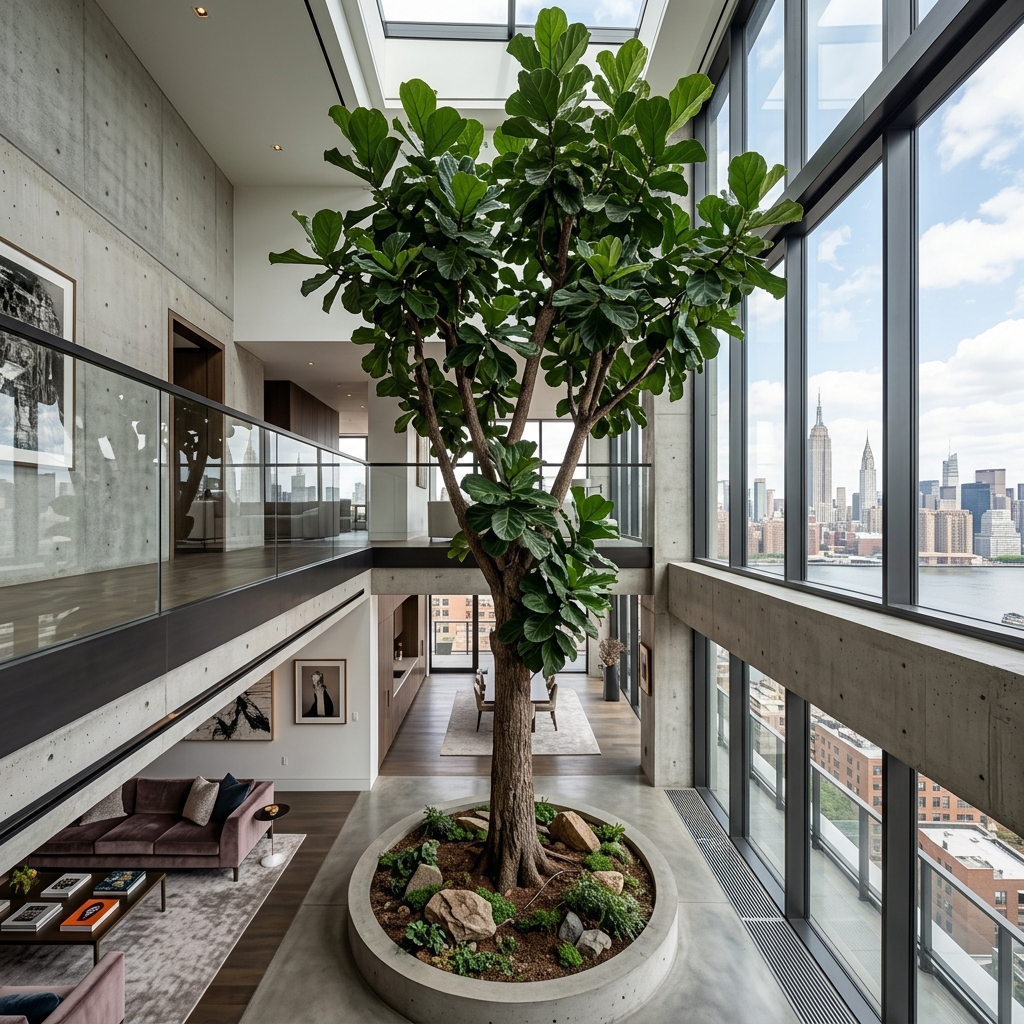
There is a stark, almost intimidating beauty in the juxtaposition of raw, brutalist architecture and the ancient, chaotic geometry of a mature tree. In the upper echelons of luxury interior design, the integration of monumental arboreal specimens has transcended mere biophilia; it has become a profound statement of structural mastery and spiritual grounding. To anchor a twenty-foot, multi-century-old olive tree directly into the continuous slab of a minimalist living room is to orchestrate a dialogue between the eternal forces of nature and the uncompromising precision of human engineering.
The psychological impact of living alongside a massive indoor tree is immediate and deeply visceral. It introduces a towering pillar of organic life into a space otherwise defined by cold geometry and stark lines. As the sunlight—manipulated through massive structural skylights—filters through the canopy, it casts a dynamic, ever-shifting shadow play across the walls. This slow, silent movement grounds the inhabitant in the present moment, offering a profound sense of permanence and tranquility that cannot be replicated by inanimate art.
From a spiritual perspective, the tree acts as an energetic anchor. It brings the deep, resonant frequencies of the forest floor into the pristine sanctuary of the home. Inhabitants often describe a tangible softening of the atmosphere, a subtle shift in the air quality that invites deep, restorative breaths. The tree becomes a silent guardian of the space, a living entity that absorbs the frenetic energy of the outside world and exudes a calming, ancient presence.
Yet, the poetic romance of arboreal integration is underpinned by a brutally unforgiving reality of structural engineering. A mature indoor tree is not a potted plant; it is a massive, living organism that requires a highly technical, invisible life-support system to survive. The architectural planning for such an installation must begin at the very conception of the foundation, long before the concrete is ever poured.
The true cost of this integration lies entirely out of sight. A subterranean containment vault must be engineered into the structural slab to house the massive root system, built to withstand immense hydrostatic pressure and soil expansion. This vault must be equipped with hospital-grade, automated fertigation systems that precisely deliver customized nutrient blends and oxygenated water to the roots, monitored by a network of subterranean sensors.
Furthermore, the canopy demands absolute atmospheric control. The brutalist concrete or seamless glass that surrounds the tree must be bathed in custom-tuned, photosynthetic lighting spectrums that mimic the exact circadian rhythm of the sun, all while remaining completely invisible to the human eye. The HVAC system must be heavily modified to provide the exact humidity and subtle air currents required to simulate outdoor wind, strengthening the trunk and preventing stagnation.
This level of execution tolerates absolutely zero deviation. If the subterranean drainage fails, the foundation is compromised. If the lighting spectrum is misaligned, the canopy slowly perishes, turning a monumental architectural feature into a tragic failure. The artisans capable of executing this—those vetted within the elite BiophilicHaus registry—are an extraordinarily rare hybrid of structural engineers, arborists, and lighting designers.
Consequently, monumental arboreal integration is an inherently exclusionary luxury. It demands a budgetary commitment that dwarfs traditional interior finishes, simply because the margin for error is non-existent. It is a profound flex of capital and technical prowess, demonstrating an absolute mastery over the environment.
But for those who require the ultimate psychological sanctuary, the investment is beyond question. To sit in the silent, imposing shadow of an ancient tree, suspended within a hyper-modern concrete monolith floating high above the city, is an experience of unparalleled spiritual dominance.
It is the ultimate realization of biophilic design: not merely bringing nature indoors, but entirely erasing the boundary between the architectural vessel and the living earth.