The definition of luxury has fundamentally shifted. It is no longer defined by the mere accumulation of rare materials, but by the absolute curation of psychological sanctuary. In an era where high-net-worth individuals are subjected to relentless cognitive overload, the primary residence must serve as a biological reset. This is the domain of neuro-architecture, a discipline that bridges the gap between structural engineering and human cognitive performance.
Surrounding oneself with highly engineered natural elements is not an aesthetic afterthought—it is a documented neurological intervention. Studies published by Nature have consistently shown that exposure to the fractal geometries of leaves and the organic irregularity of bark inherently lowers cortisol production. This exposure shifts the autonomic nervous system out of a sympathetic 'fight or flight' state and into a restorative, parasympathetic rhythm.
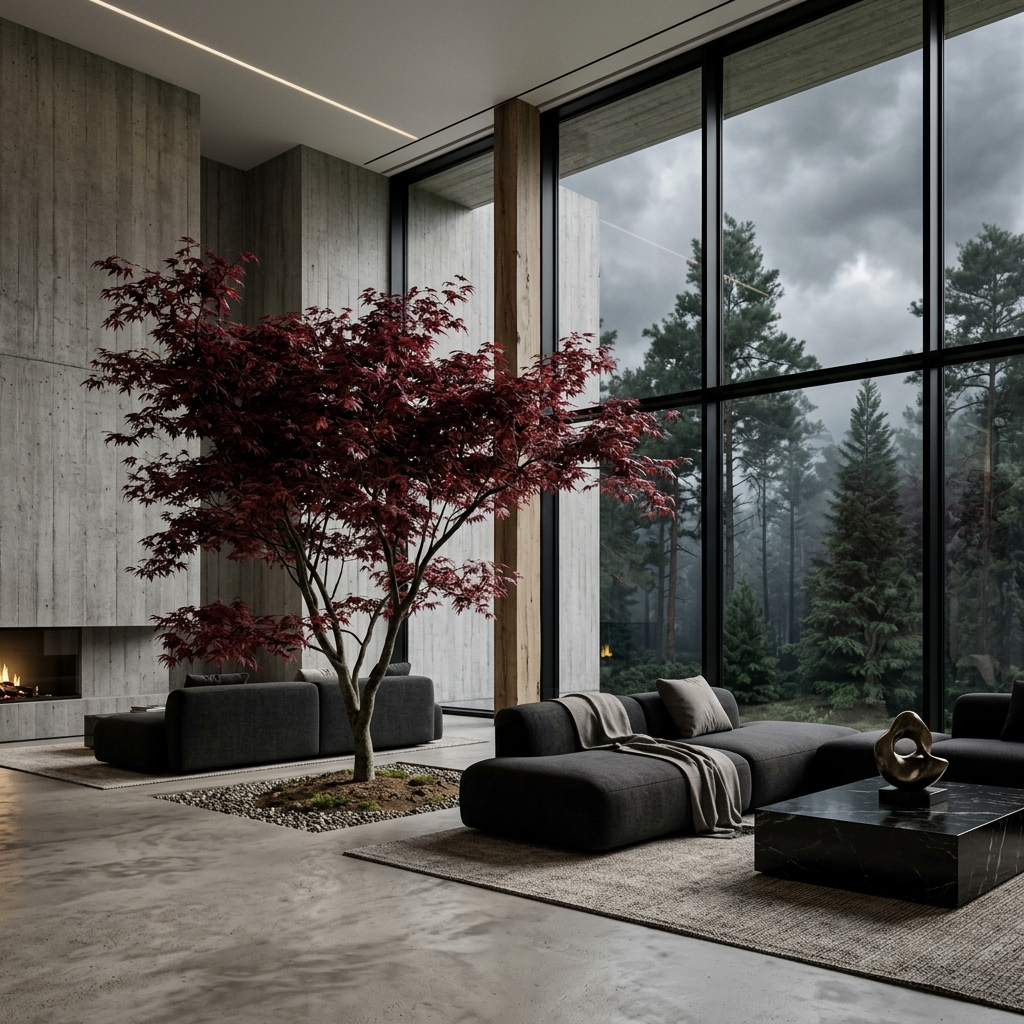
However, true neuro-architecture is inherently exclusionary. It cannot be retrofitted. Consider the integration of a mature Japanese maple anchored directly into the structural slab of a brutalist living room. This requires massive subterranean irrigation, root-barrier engineering, and custom-tuned photosynthetic lighting spectrums—all flawlessly hidden beneath seamless microcement floors. It is a zero-margin-for-error pursuit that must be engineered into the foundation at an immense premium.
We see this evolution extending to the periphery of the home as well. Structural glass walls achieve a similar psychological effect by eradicating the visual boundary between the engineered sanctuary and the wild landscape. The architectural framing of a moody pine forest or a crashing ocean wave through uninterrupted, load-bearing glazing forces the mind to expand, aligning the inhabitant's internal state with the vastness of the exterior world.
The psychological ROI of high-end wellness design cannot be overstated. When the home is optimized to support circadian rhythms via meticulously modeled sun-paths and natural light corridors, the inhabitant experiences a profound alignment with the natural cosmos. The home becomes an active participant in their biological regulation.
Beyond visual stimuli, true neuro-architecture must address the olfactory and acoustic environment. The integration of large-scale indoor botanicals acts as a passive, hospital-grade filtration system. By absorbing volatile organic compounds (VOCs) and releasing hyper-oxygenated air, these living installations ensure that every breath taken within the residence is actively regenerating cellular health. This level of atmospheric purity is impossible to achieve through mechanical HVAC systems alone; it requires a living, breathing ecosystem integrated directly into the floor plan.
Acoustically, the materials chosen for these spaces play a critical role in mental clarity. The density of poured concrete and the acoustic dampening properties of hand-troweled finishes absorb the harsh, high-frequency reverberations typical of modern glass-and-steel boxes. Instead, the auditory landscape is softened. When combined with the subtle white noise of an integrated hydro-suite, the home effectively drowns out the chaotic frequencies of the metropolis, wrapping the inhabitant in a cocoon of absolute silence and focus.
This is why the artisans vetted within the BiophilicHaus registry are not merely decorators; they are material scientists and spatial psychologists. The execution of these biophilic integrations requires a level of precision that tolerates absolutely no deviation. A single flaw in the microcement pour or a slight misalignment in the structural glazing immediately breaks the illusion of seamless integration, destroying the neuro-architectural effect.
From an asset valuation perspective, the data is undeniable. According to reports from Architectural Digest, properties featuring structural biophilic integrations command up to a 35% premium on the luxury real estate market. But for the elite buyer, the financial return is entirely secondary to the biological return. They are purchasing the ability to dictate their own cognitive state.
Ultimately, to invest in this level of luxury biophilic interior design is to invest in cognitive dominance. It is the profound understanding that true wealth is the ability to dictate your own biological environment.
Isolating oneself from the chaos of the metropolis to achieve unparalleled, spiritual grounding is the ultimate status symbol of the 21st century. It is architecture that doesn't just shelter the body, but actively rewires the elite mindset.